


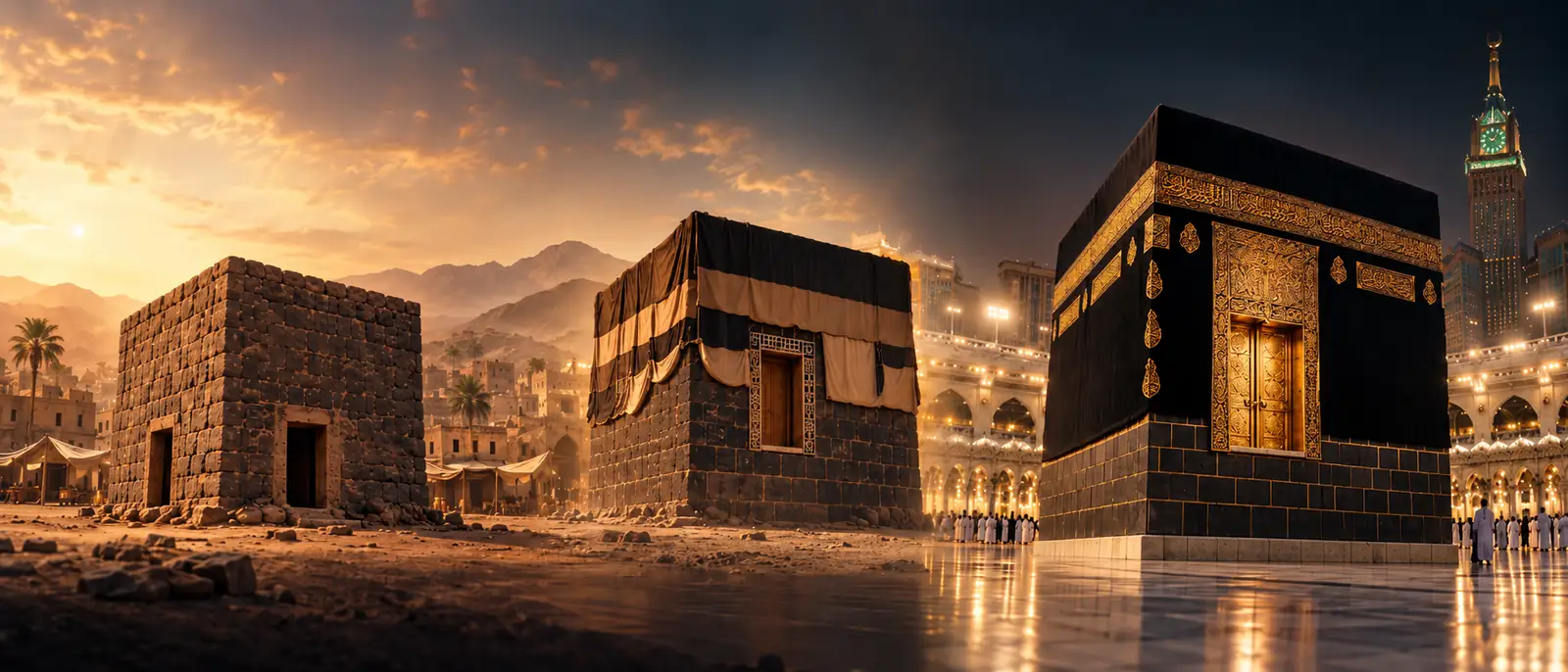
History of the Kaaba Door (Baitullah) - From Prophet Ibrahim (AS) to the Golden Door Today
Kaaba Door - History, Inscriptions, Design & Significance
There’s only one entrance to Baitullah, the Kaaba door, and it’s the House of Allah in Makkah. First of all, the Prophet Ibrahim (AS), along with his son Ismail (AS), constructed the original structure of the Kaaba with two ground-level openings, one on the eastern side and the other on the western side, without installing a lock on the door; later, the Kaaba was raised off the ground by 7 feet, and the door was replaced several times, with a door weighing 280 kg of pure gold installed in 1979 that is still in place.
The Kaaba, also known as Baitullah (Arabic: بيت الله), which means The House of Allah, and every Muslim from the world faces in the same direction Kaaba located.
In this guide, we’ll talk about the full timeline of the doors of the Kaaba, from the first simple door to the golden one we see today.
Quick Facts
Detail |
Answer |
|---|---|
| Name | Bab al-Kaaba (باب الكعبة) (or Bab ar-Rahmah / Door of Mercy). |
| Location | East side of the Kaaba |
| Height above the Mataf | About 2.25 m |
| Size | About 3.1 m high, 1.9 m wide |
| Material | Pure 24-carat gold |
| Gold weight | About 280 kg |
| Year made | 1399 AH (1979 CE) |
| Ordered by | King Khalid bin Abdulaziz |
| Key holder | The Al-Shaiba family (Bani Shaiba) |
What Is Baitullah?
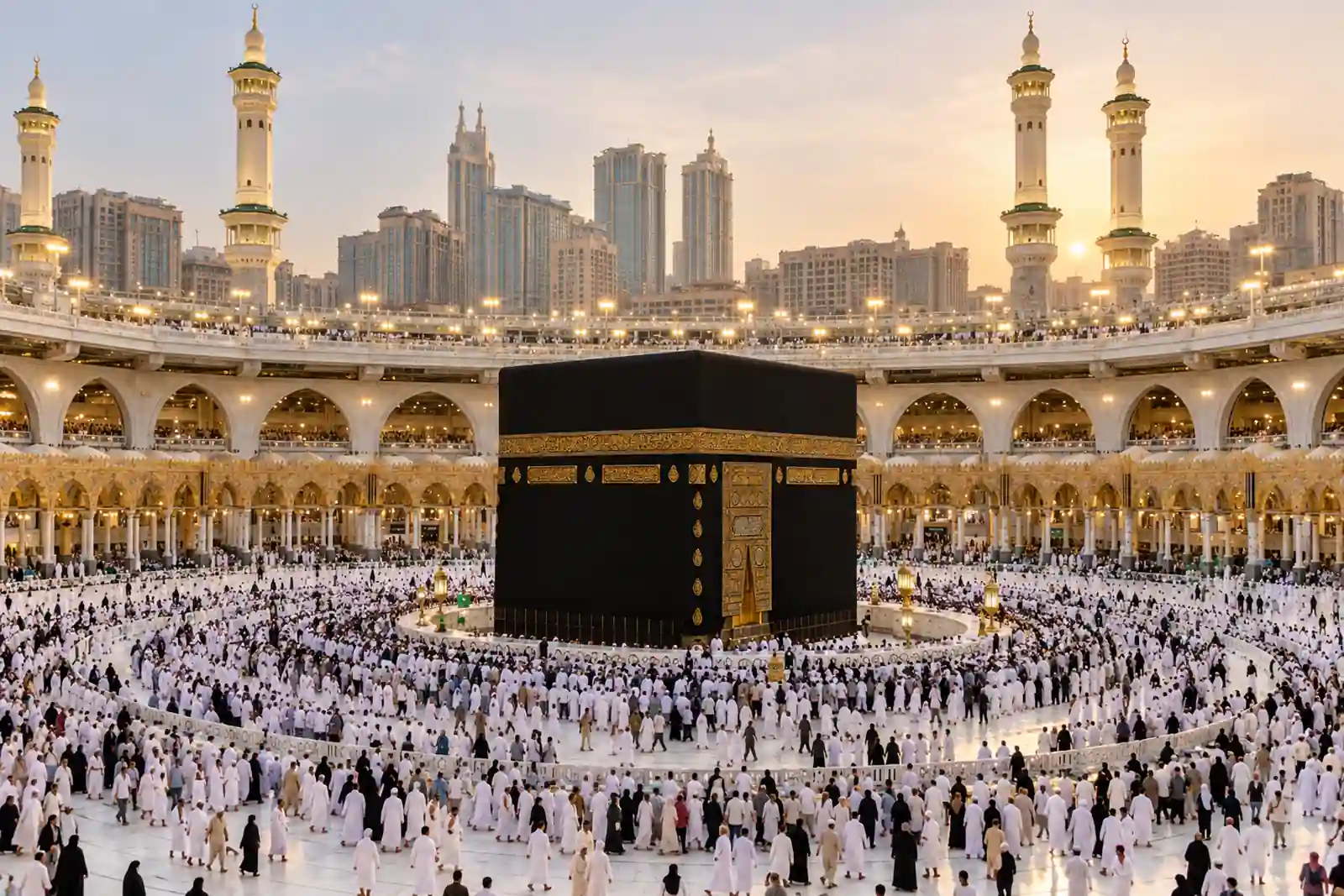
The House of Allah, Baitullah. We as Muslims use this name for the Kaaba because we worship Allah alone, he’e almighty, the deity and Omniscient.
The Kaaba is situated right in the centre of the Grand Mosque in the holy city of Makkah, and Muslims face it in every prayer regardless of their country or location.
In Arabic, the door of Kaaba name is Bab al-Kaaba (باب الكعبة). And the door of the Kaaba in Urdu is called Bab-e-Kaaba (باب کعبہ) in Urdu.
The Kaaba Door Timeline at a Glance
This table shows how the doors of the Kaaba changed over time.
Era |
Ruler or builder |
Door |
|---|---|---|
| Earliest period | Prophet Ibrahim (AS) and Ismail (AS) | Simple first door of Kaaba, set on the ground |
| circa 608 CE | Quraysh | Door raised above ground level |
| circa 630 CE | Prophet Muhammad ﷺ | Kaaba cleansed of idols; Al-Shaiba key custody noted |
| 683 CE onward | Ibn al-Zubayr | Rebuilt after fire; reports of a 2nd door of Kaaba |
| Umayyad to Mamluk | Caliphs and sultans | Door kept in repair |
| 1631 | Ottoman sultans | Kaaba and mosque rebuilt after the 1630 flood |
| 20th century | Saudi state | Door maintained during Grand Mosque projects |
| 1979 | King Khalid | Pure gold Kaaba door |
The First Door - Ibrahim (AS) and Ismail (AS)
Based on Islamic tradition and historical sources, the Prophet Ibrahim (AS) and Ismail (AS) built the original structure of the Kaaba in c. 2000 BCE, with two open portals, eastern for entrance and western for exit, set directly on the ground.
The first locking door was built in 350 CE, in the late 4th century. Built and gifted by King Tubba III (Abu Karib) of Yemen.
The Quraysh Rebuild - Why the Door Was Raised
In 608 CE, the Quraysh rebuilt the Kaaba, along with raising the door of the Kaaba by 2.20 to 2.25 metres above ground level, protecting it from floodwater and intruders (security/political control).
Authentic Hadith:
Aisha reported: The Prophet, peace and blessings be upon him, said to her, “O Aisha, had your nation not recently left ignorance, I would have had the Ka’bah pulled down and rebuilt to include the portion which had been missing. I would have made it level with the ground, with two doors, one towards the east and the other towards the west. By doing so, it would have been upon the foundation laid by Abraham (Source: Sahih Muslim 1333a).
Why the Door Has Never Returned to Ground Level
Being elevated from the ground level indicates that it safeguards against floodwater and still controls access, since floods struck Makkah several times in history. And that’s the main reason it was elevated for the first time to cope with this danger.
Ibn al-Zubayr, the Fire of 683 CE and the Two-Door Question
In 683 CE, during a fierce siege by the Umayyad caliph Yazid I, a devastating fire severely damaged the structure of the Kaaba. Abdullah ibn al-Zubayr, who held control over Makkah, took the opportunity to completely rebuild the sanctuary using stone.
To honour the precise, historical foundations of Prophet Ibrahim (AS) and fulfil the structural wish of Prophet Muhammad ﷺ, he altered the layout to feature two ground-level doors: an eastern entrance and a western exit. This historical event is the definitive source of the "second door" narrative.
This is the source of the idea of a 2nd door of Kaaba. Today, only one Kaaba door stays in use.
Umayyad, Abbasid and Mamluk Care for the Door
In the Umayyad, Abbasid and Ottoman periods, the caliphs and sultans repaired and replaced the Kaaba door to keep it in the right condition for the sacred house.
The traveller Ibn Jubayr saw the Kaaba in 1183. He found it still kept its eighth-century Abbasid form.
From 1269 to 1517, the Mamluks of Egypt ruled the Hijaz. Sultan Qaitbay built a school beside the mosque in that era.
The Ottoman Era and the 1630-31 Flood Rebuild
The Ottomans heavily renovated the mosque under Sultan Suleyman I and Selim II, funded by them. Then floods hit in 1630 and destroyed the Kaaba and the mosque; Sultan Suleyman I and Selim II were not alive during the 1630 flood.
Sultan Murad IV of the Ottoman Empire, who was the ruler at the time, ordered and funded the entire 1630-1631 demolition and structural rebuild of the Kaaba; it’s the same Mosque that we see standing today.
This history shows why the raised door of Kaaba mattered; since the floodwater had to stay out of the House.
The Saudi Era - From Earlier Doors to the Golden Door of 1979
Since the start, several major expansions have been done by different kings of their time, while caring for the door as part of Grand Mosque projects.
To accommodate the rapidly rising number of pilgrims, in 1955 the first historic Saudi expansion modernised the grand mosque.
In 1399 AH (1979 CE), King Khalid bin Abdulaziz ordered a new Kaaba door of pure gold to replace the previous one, masterfully handcrafted by artisans using 280 kg of pure 24-carat gold. Makers shaped it with fine Islamic geometric patterns and Arabic calligraphy featuring holy Quranic verses.
Design, Gold and Dimensions of Today's Door
This is the question of many people: Is the door of Kaaba made of gold? Yes, it is. The makers used 280 kg of pure 24-carat gold to build the door of the Kaaba.
The Kaaba door stands 3.1 m high and 1.9 m wide. It has two large rings for opening it. It sits 2.25 m above the Mataf floor, so a metal staircase leads up to it when the door opens. Compared with older doors of the Kaaba, this one is the most valuable in the world's sacred architecture; SPA says it’s one of the most valuable doors anywhere worldwide.
Here’s a short table:
Detail |
Saudi Press Agency (SPA) |
|---|---|
| Year | 1979 |
| Gold weight | About 280 kg |
| Height above ground | About 2.25 m |
| Width | About 1.9 m |
What are the Inscriptions and Calligraphy on the Kaaba Door?
Here’s the table in detail of every inscription and calligraphy on the door:
Location / Section |
Inscription / Text |
Source / Reference |
Meaning or Significance |
|---|---|---|---|
| Top of the door | Allah Jalla Jalaluhu and Muhammad ﷺ | Names of Allah and the Prophet ﷺ | Highlights the central Islamic declaration of faith and reverence for Allah and His Messenger ﷺ. |
| Upper door panels | “Enter it in peace and security.” | Qur’an 15:46 | Refers to entering Paradise in peace and security. |
| Upper door panels | “My Lord, cause me to enter a sound entrance and to exit a sound exit…” | Qur’an 17:80 | A supplication asking Allah for a good entrance, good exit and His support. |
| Upper door panels | “Your Lord has prescribed mercy upon Himself.” | Qur’an 6:54 | Emphasises Allah’s mercy towards His servants. |
| Upper door panels | “Call upon Me; I will respond to you.” | Qur’an 40:60 | Reminds believers to turn to Allah through supplication. |
| Lower section | “O My servants who have transgressed against themselves, do not despair of the mercy of Allah…” | Qur’an 39:53 | A powerful reminder of Allah’s forgiveness and mercy. |
| Door medallions | Shahadah: “There is no god but Allah; Muhammad is the Messenger of Allah.” | Islamic declaration of faith | Expresses the foundation of Islamic belief. |
| Around the lock | Surah Al-Fatihah | Qur’an 1 | The opening chapter of the Qur’an, containing praise of Allah and a prayer for guidance. |
| Door rings | Allahu Akbar | Takbir | Declares the greatness of Allah. |
| Decorative panels | Divine Names of Allah | Names and attributes of Allah | Adds religious meaning to the ornate design surrounding the door. |
The Door Curtain
The curtain of the Kaaba door is called Sitara (also known as the Burqu'); it’s a very heavily embroidered curtain 7.5 metres high and 4 metres wide. Due to its massive size, the curtain is integrated into the larger Kiswah (black cloth that covers the Kaaba), so that its calligraphy, made with gold and silver thread, aligns perfectly and frames the 3.1-metre-high golden door beneath it. This curtain is replaced each year during Hajj.
The Al-Shaiba Family: Keepers of the Key
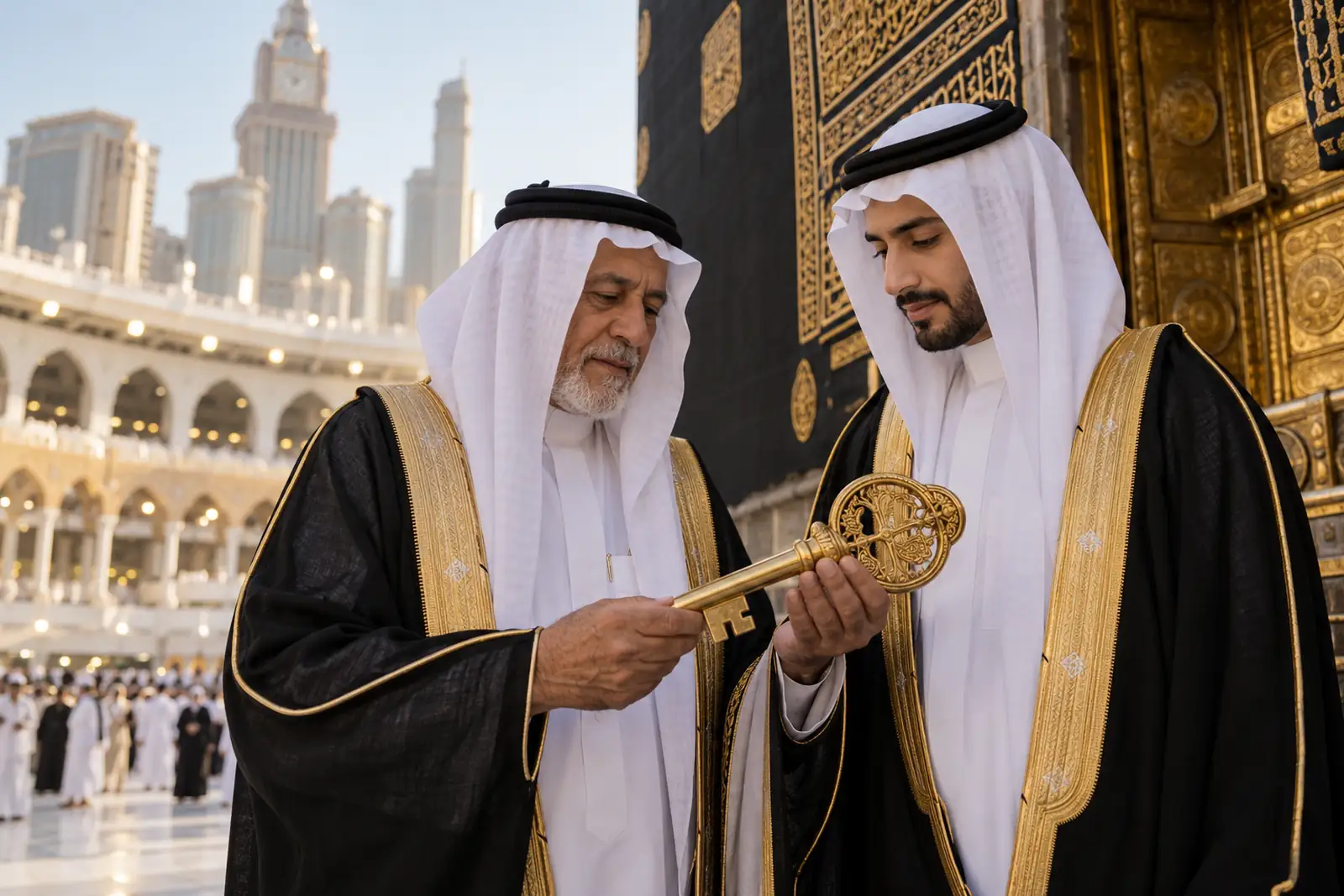
The Al-Shaiba family guards the key as part of the hereditary duty of safeguarding the key for the 1400 years, since the time of Prophet Muhammad in 630 CE. So far, 78 chief caretakers have been assigned, and 110 successive keepers have been appointed since their pre-Islamic ancestor, Qusayy ibn Kilab.
When Is the Door Opened Today?
Staff open the door on set occasions, such as Ceremonial Washing (Ghusl al-Kaaba), using Zamzam water mixed with premium rose water and luxury oud oils, which happens once a year. Officials, scholars, and the Al-Shaiba caretakers attend to wash.
The door of the Kaaba stays closed year-round. Regular pilgrims do not enter the Kaaba, as there are millions of pilgrims who perform Umrah and Hajj. They worship around it during tawaf.
Touching the Door and the Multazam - What Pilgrims Should Know
The part of the wall between the Back stone and the Kaaba door is known as Multazam. Many pilgrims try to make dua there when crowds allow, without pushing or hurting other pilgrims.
Authentic Hadith: “I saw the Messenger of Allah ﷺ place his chest, his hands, and his cheek flat against it.” (Sunan Abu Dawood, 1899)
Touching the door of the Kaaba is not a required part of tawaf, and your tawaf stays valid without it.
Seeing the Door on Umrah or Hajj
During Tawaf, the Kaaba door can be seen from the Mataf. Crowds usually keep changing throughout the day, so ask your guide for the calmer hours. Follow the mosque's photo rules and put your phone away during worship.
The Messenger of Allah ﷺ said to Umar (RA): "O Umar, you are a strong man, so do not push through the crowds to reach the Stone, lest you harm the weak. If you find a clear space, then touch it; otherwise, just face it and say the Takbir (Allahu Akbar)." (Musnad Ahmad, 19o).
Plan Your Umrah with Itimaar
Would you like to turn your dream to visit holy places into reality? Plan your Umrah journey with Itimaar today; choose from 4-star and 5-star Umrah packages with flights, hotels, transfers and support.
We’ll help you find an Umrah package that suits your dates, budget and travel needs.
Request your personalised Umrah quote today and start planning your sacred journey.
Frequently Asked Question
How many doors of Kaaba are there?
For now, the Kaaba has only one door on the eastern side known as Bab al-Kaaba, but in 683 CE, Abdullah Ibn al-Zubayr once built two doors resembling the original layout of Prophet Ibrahim (AS): one on the eastern entrance and a western exit, but only one stays in use.
Is the Kaaba door made of gold?
Yes. The current door is made up of 280 kg of pure 24-carat gold.
What is the door of the Kaaba name in Urdu?
In Urdu, it is called Bab-e-Kaaba (باب کعبہ). In Arabic, it is Bab al-Kaaba.
Is there a hidden door of Kaaba?
No, there’s no hidden door of Kaaba. There were two doors, and the second door's structural outline is clearly visible from outside, so there’s nothing like a hidden door of the Kaaba.
