


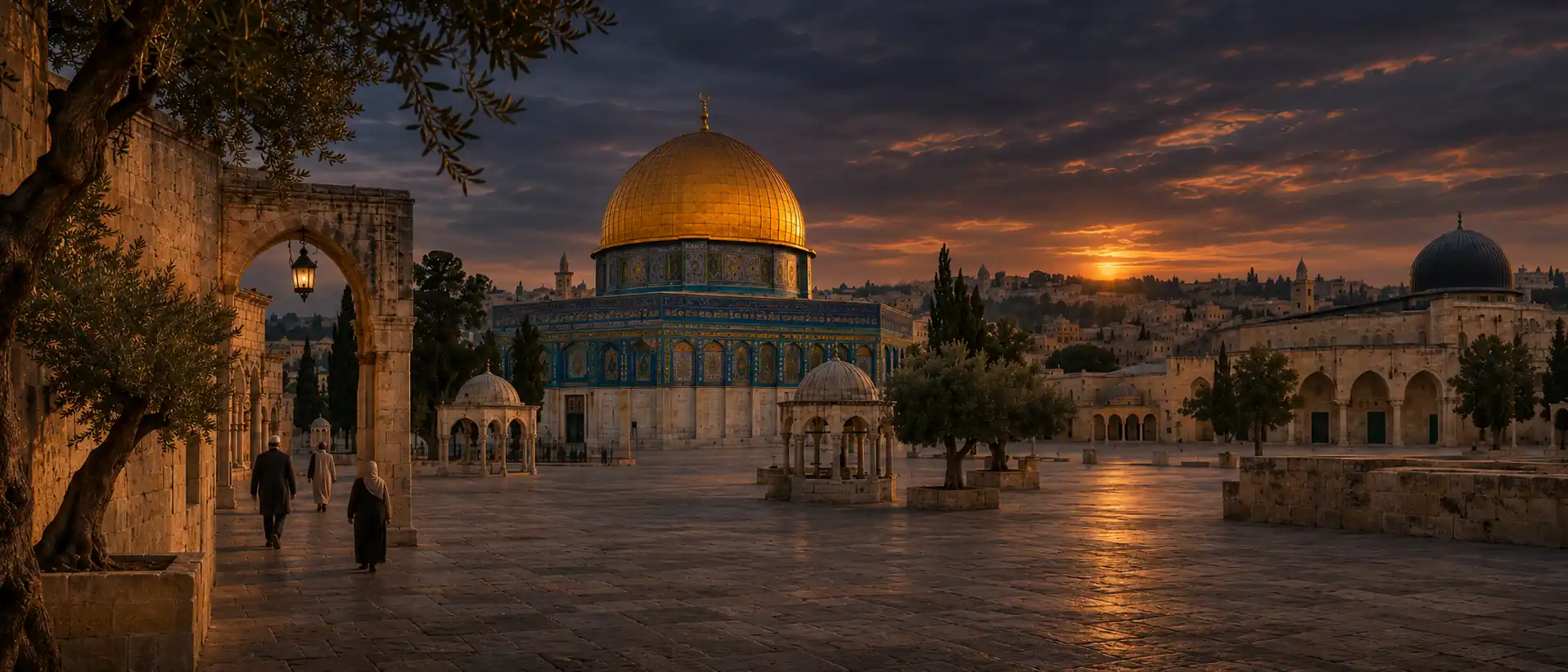
Masjid Al Aqsa - History, Facts, Location and Significance in Islam
The History of Masjid Al Aqsa and Its Importance in Islam
Masjid al-Aqsa is the third holiest mosque in Islam, situated in the Old City of Jerusalem. This mosque is also known as ‘the Furthest Mosque, ’ which comes directly from the Quran 17:1 (Surah Al-Isra), since this mosque is located far from Mecca.
Muslims use Masjid al-Aqsa for the whole 144-dunam (35-acre) sanctuary, which has both the silver-domed Qibli Mosque and the gold-domed Dome of the Rock.
Key Facts at a Glance
Fact |
Answer |
|---|---|
| Name | Masjid al-Aqsa (Al-Masjid al-Aqsa), "the Furthest Mosque" |
| Location | Masjid al-Aqsa, Jerusalem; it sits in the Old City |
| Rank in Islam | Al-Aqsa Mosque is the third holiest mosque |
| First qibla | Yes, for about 16 to 17 months after the Hijrah |
| Compound size | About 144 dunams (14.4 hectares) or (35 acres) |
| Qibli Mosque size | About 83 m by 56 m, room for around 5,000 worshippers |
| Administration | Jerusalem Islamic Waqf, under Jordanian custodianship |
| Key dates | About 637/638 (Umar), c. 691/692 (Dome of the Rock), 1187 (Salahuddin), 1969 (fire) |
| Do not confuse | Dome of the Rock is not the Al-Aqsa Mosque |
What Is Masjid Al Aqsa?
Masjid al-Aqsa has both a whole sanctuary and a single hall for prayer; this mosque complex is the entire 144-dunam walled area.
Meaning of the Name "Al-Aqsa"
The word Al-Aqsa means the furthest or is used to indicate a distant place; this is also stated in the Quran, Surah al-Isra (17:1), especially for Masjid al-Aqsa مسجد. This is the same Mosque to which the Prophet ﷺ (PBUH) travelled by night.
You may see Al aqsa masjid or Masjid al-Aqsa; all of these spellings refer to Masjid al-Aqsa, one blessed place.
Al-Haram ash-Sharif vs Al-Qibli Mosque
Al-Haram ash-Sharif means the Noble Sanctuary, which is the whole raised platform that forms Masjid al-Aqsa, about 144 dunams. The Qibli Mosque (Al-Jami' al-Aqsa) is the large prayer hall located at the south end.
Based on solid proof compiled from four primary Islamic sources- the Quran, Hadith, classical jurists and official modern fatwas- the entire 144-dunm walled area constitutes Masji al-Aqsa; that means praying anywhere inside its walls is considered praying in Masjid al-Aqsa.
Other Names and Structure
Other notable structures in Masjid al-Aqsa include the Marwani Prayer Hall, which lies under the south-east corner, and the Dome of the Chain is located just east of the Dome of the Rock; Muslims call this Al-Buraq Wall because the Prophet Muhammad (PBUH) tethered his winged steed, Al-Buraq, there during his night journey. Multiple gates provide access to the crowd and mark the entrance into one unified mosque.
Masjid Al-Aqsa vs. Dome of the Rock - How to Tell Them Apart
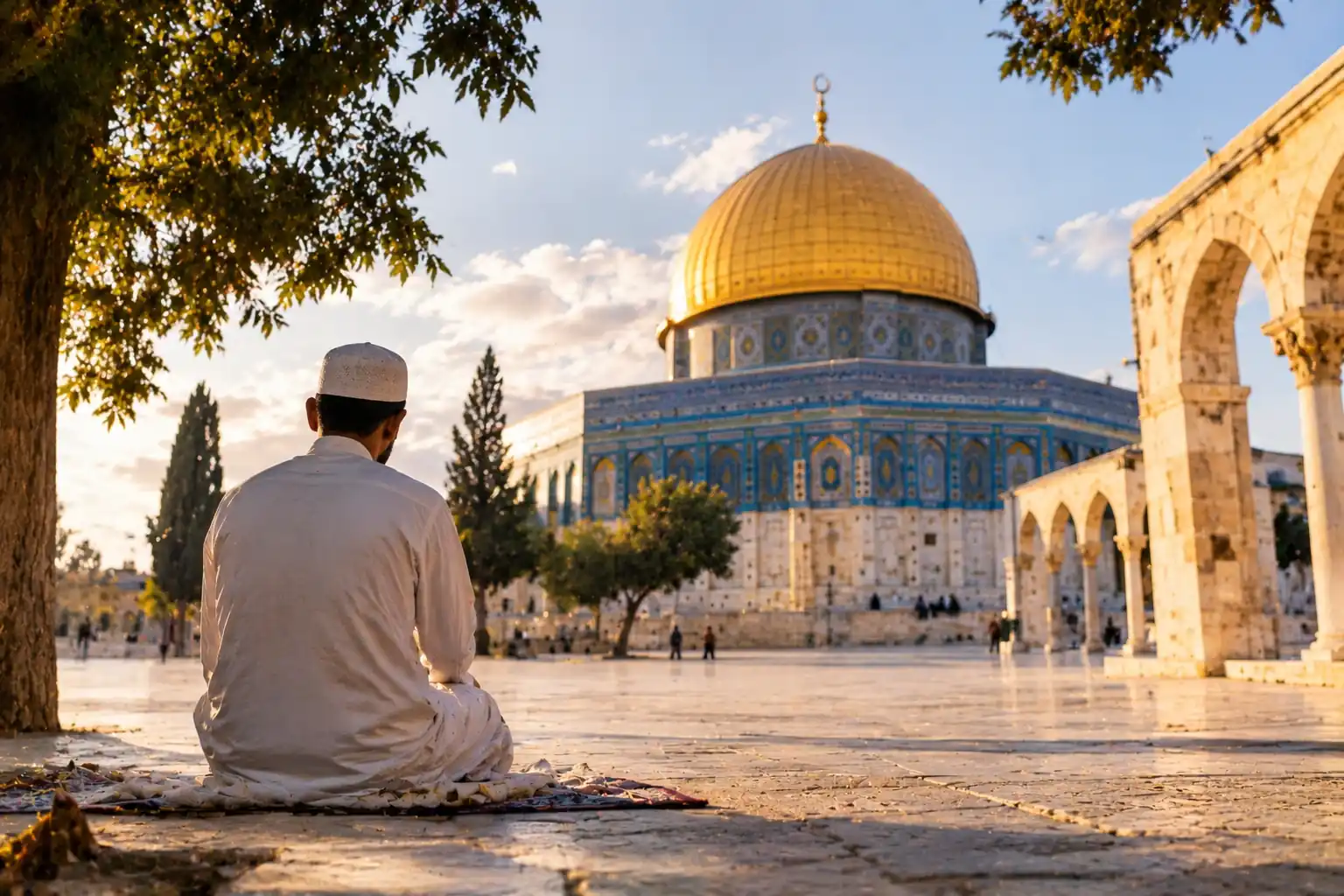
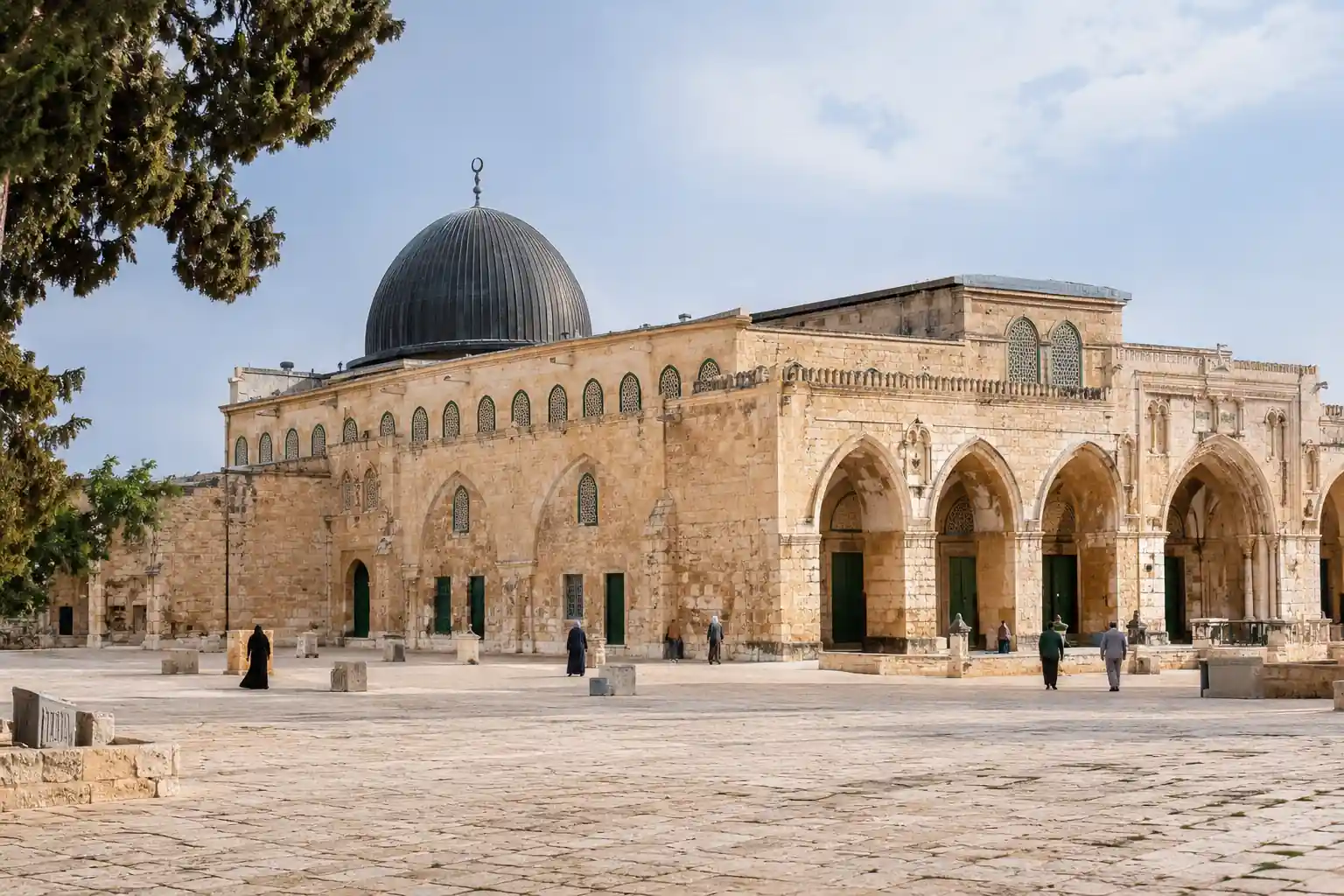
You should be clear that the Dome of the Rock is not Masjid al-Aqsa; it’s a separate shrine with a golden dome in the middle of the elevated upper terrace, and the Qibli Mosque of Al-Aqsa has a dark-grey coloured dome.
Feature |
Al-Aqsa (Qibli) Mosque |
Dome of the Rock |
|---|---|---|
| Dome colour | Dark grey | Gold |
| Shape | Long prayer hall | Eight-sided shrine |
| Job | Main mosque for daily and Friday prayers | Shrine built around the rock |
| Position | South end of the platform | Centre of the platform |
| Built | Umayyad era, rebuilt many times | About 691/692 |
Where Is Masjid Al Aqsa Located?
Located in the Old City of East Jerusalem, in the south-east corner of the walled city, Masjid al-Aqsa in Jerusalem is located around 1,200 km from Makkah and around 900 km from Madinah when measured in a straight line. And most countries and the UN do not recognise Israeli sovereignty over East Jerusalem.
Map and Gates
Several gates lead into Masjid al-Aqsa:
- Bab al-Asbat (Gate of the Tribes), at the north-east corner (reached from the Old City's Lions' Gate)
- Bab al-Silsila (Chain Gate), on the west side
- Bab al-Magharibeh (Moroccans Gate), the only entrance for non-Muslim visitors
- Bab al-Rahmah (Golden Gate), on the east wall and now sealed
Significance of Masjid Al-Aqsa in Islam
5 major reasons that make it matter the most:
The First Qibla
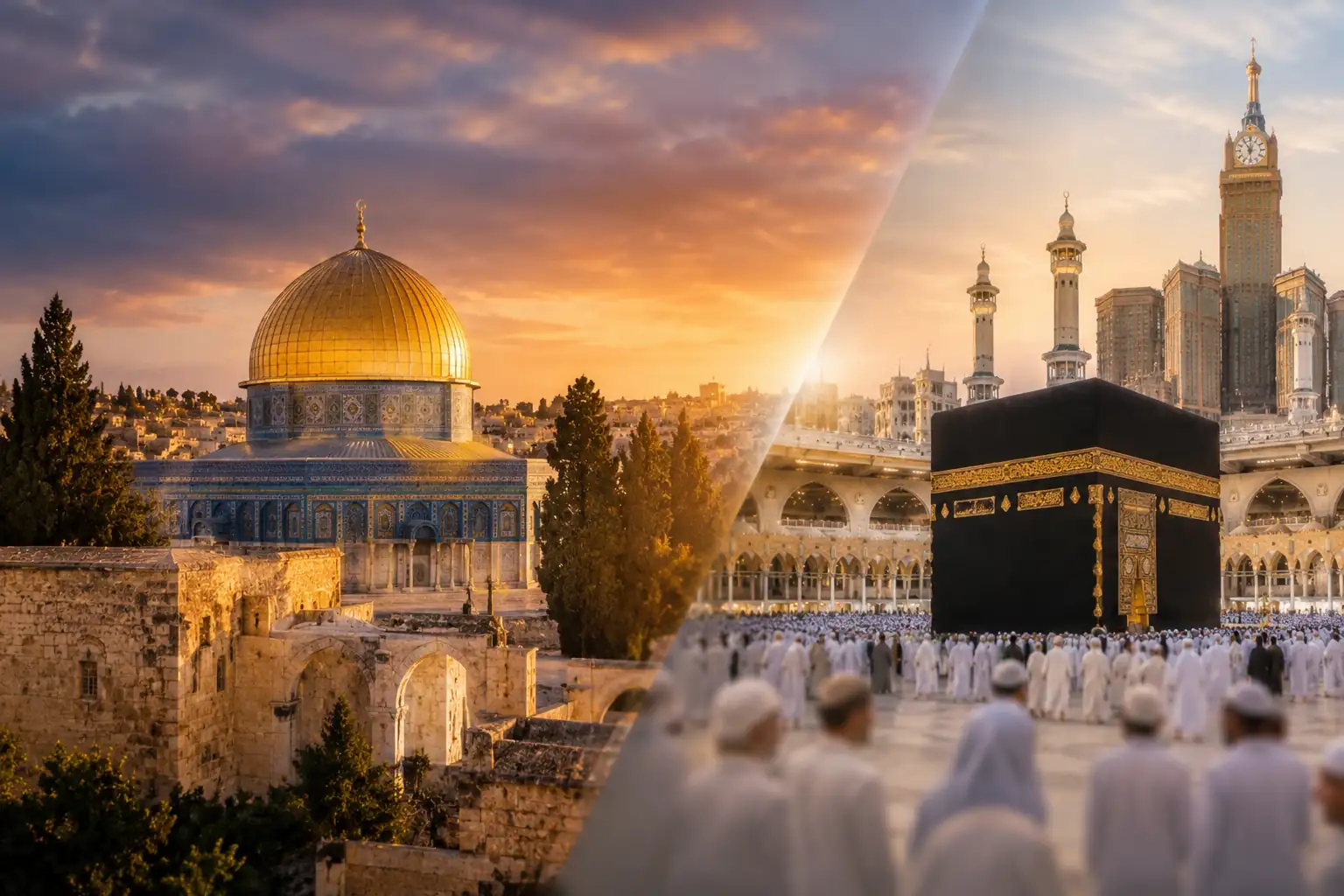
Initially, Prophet Muhammad (PBUH) and Muslims faced Jerusalem Masjid al-Aqsa for about 16 to 17 months following the Hijrah. After that, Allah revealed verses in Surah Al-Baqarah (Quran 2:142-144) commanding the Prophet Muhammad (PBUH) to turn the face towards the Kaaba in Makkah, permanently setting it as the qibla.
Isra and Miraj
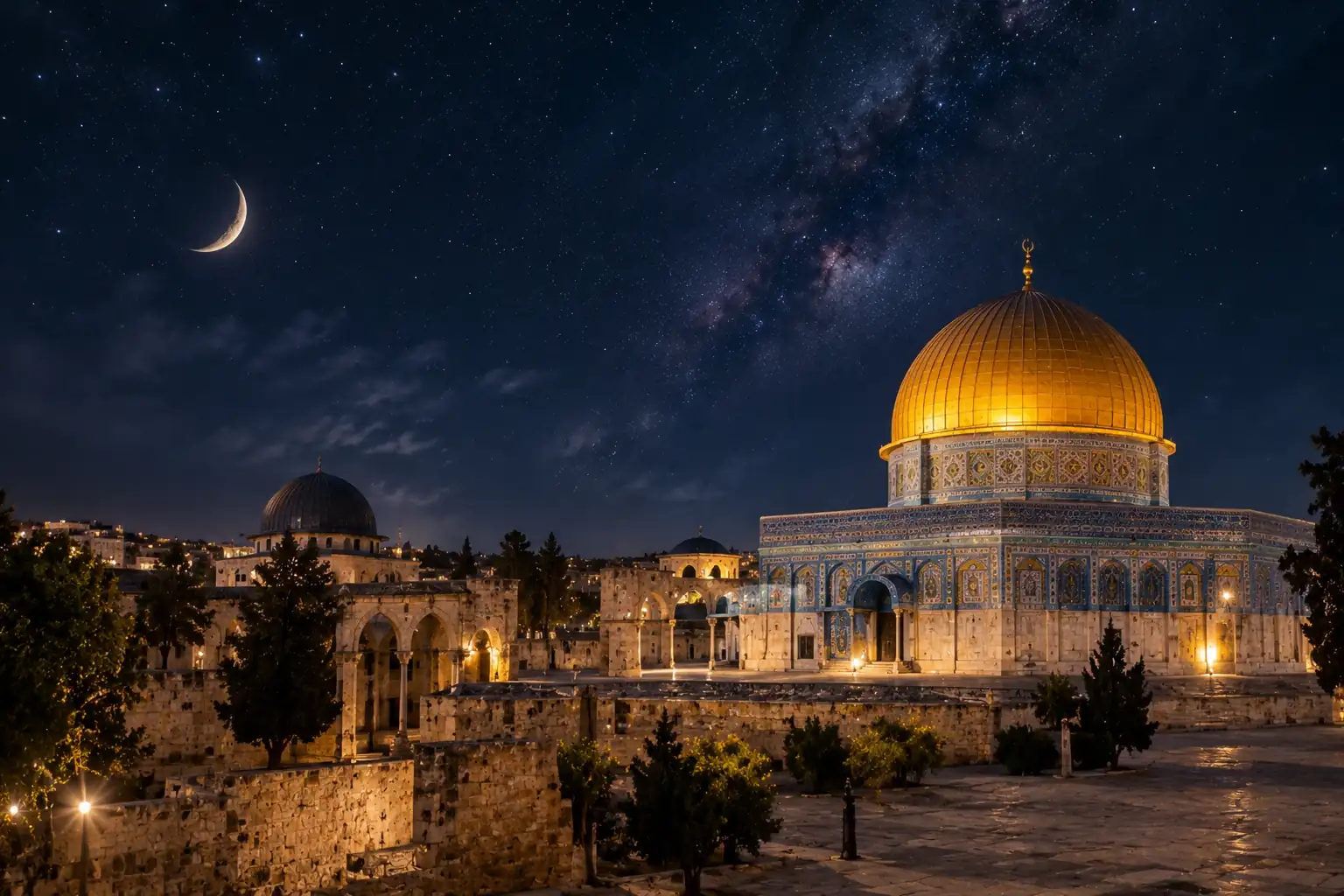
The Prophet ﷺ travelled from Makkah to Masjid al-Aqsa in one night on the Buraq. He led the earlier prophets in prayer at Masjid al-Aqsa. Then he rose through the heavens. Allah gave the five daily prayers on that journey. Quran 17:1 (Surah Al-Isra) records the first half of this trip from Masjid al-Haram to Al-Masjid al-Aqsa.
One of the Three Mosques to Journey To
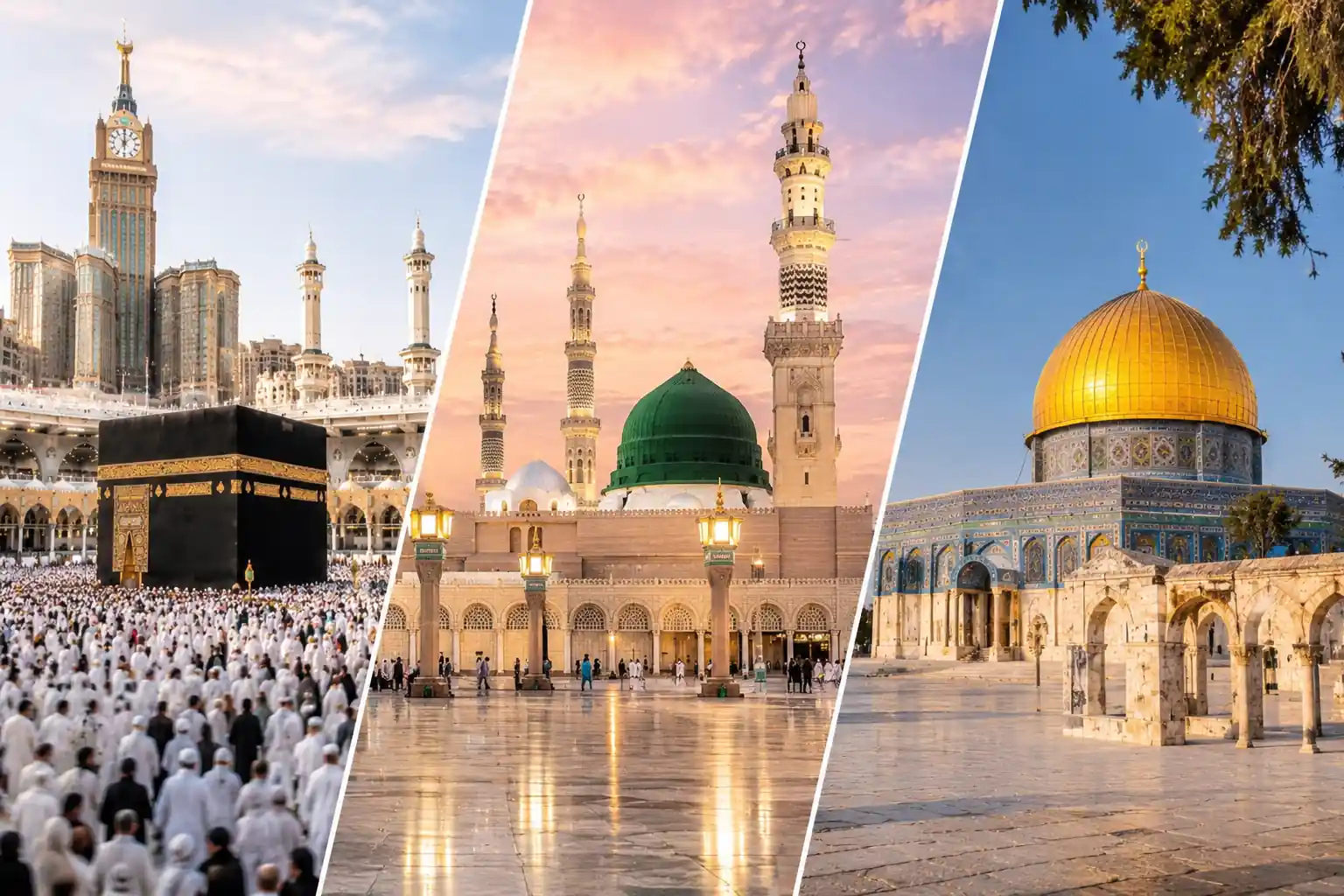
Abu Hurayrah (RA) reported that the Prophet ﷺ said Muslims should travel only to three mosques. They are Al-Masjid al-Haram, the Prophet's Mosque in Madinah, and Masjid al-Aqsa (Sahih al-Bukhari 1189 and Sahih Muslim 1397).
Virtues and Rewards of Praying There
Praying in Masjid al-Aqsa is a great act of worship; prayer in Bayt al-Maqdis is better than five hundred prayers elsewhere. (Shu’ab al-Imān 3845 ). Ask a trusted scholar when in doubt.
"The Land We Have Blessed"
Quran 17:1 says Allah blessed the area around Masjid al-Aqsa. Quran 21:71 and 21:81 call the land blessed in the stories of Ibrahim and Sulayman (peace be upon them).
Built 40 Years After the Kaaba
Abu Dharr (RA) asked which mosque was built first. The Prophet ﷺ said Al-Masjid al-Haram. Then Abu Dharr asked which came next. The Prophet ﷺ said Al-Masjid al-Aqsa. He added that 40 years lay between them (Sahih al-Bukhari 3366 (also 3425) and Sahih Muslim 520a (Narrated by Abu Dharr al-Ghifari).
Why Al-Aqsa Mosque Matters to Muslims Today?
This is the third holiest mosque on earth, which was considered the Qibla initially for 16-17 months (Jerusalem). This is one of the mosques to which Prophet Muhammad encouraged Muslims to undertake a religious journey (Sahih al-Bukhari 1189).
Many UK Muslims plan Umrah first and Masjid al-Aqsa second. Itimaar's 4- and 5-star Umrah packages cover Makkah and Madinah, so you can start your Umrah journey with one trusted team.
History of Masjid Al Aqsa
So, who built Masjid Al-Aqsa?
According to Islamic tradition, prophets built and rebuilt the sanctuary long before Islam. The mosque you see today grew from Umar's prayer hall and the Umayyad caliphs' building, then centuries of rebuilding.
Read the eras mentioned below to understand who built Masjid al-Aqsa in order:
Prophetic and Early Tradition
Islamic tradition links Ibrahim, Ishaq, Yaqub, Dawud and Sulayman (peace be upon them) to Masjid al-Aqsa. Many accounts say Sulayman (AS) rebuilt Masjid al-Aqsa. Scholars differ on who first built Masjid al-Aqsa. The 40-year hadith above does not name the person.
Haz. Umar Ibn al-Khattab and the Opening of Jerusalem
Haz. Umar (RA) received the keys of Jerusalem about 637/638 without a battle. He cleared the rubbish from Masjid al-Aqsa himself and had a simple prayer hall built. That small hall was the first Muslim-era building of Masjid al-Aqsa.
The Umayyads
Mu'awiya built or improved a mosque at Masjid al-Aqsa before he died in 680 (around the 660s–670s). Abd al-Malik built the Dome of the Rock around 691/692. Abd al-Malik or his son al-Walid I built the main Umayyad congregational mosque in the late 7th and early 8th century.
The Abbasids
An earthquake damaged Masjid al-Aqsa in 746. Al-Mansur rebuilt it in 758. Al-Mahdi expanded it in 780 to fifteen aisles.
The Fatimids
An earthquake hit again in 1033. Al-Zahir rebuilt Masjid al-Aqsa from 1034 to 1036. Work finished in 1065 under al-Mustansir, and the mosque shrank to seven aisles. Parts of the northern entrance date to 1065, and mosaics from this time still cover the dome area.
The Crusader Period
The Crusaders took Jerusalem in 1099 and converted the mosque into a royal palace (and named it Templum Salomonis) and granted it to the Knights Templar as their headquarters in 1119. Thousands of Muslims who sheltered there were killed by Western European Christian Crusader armies.
Salahuddin al-Ayyubi
Salahuddin retook Jerusalem in 1187. He cleaned Masjid al-Aqsa and restored it as a mosque. He also placed the great minbar there, which Nur al-Din had ordered.
Ayyubids, Mamluks and Ottomans
Later rulers kept repairing Masjid al-Aqsa. The Ayyubid ruler al-Mu'azzam added the north porch to Masjid al-Aqsa in 1218. The Mamluk sultan al-Kamil Sha'ban added naves in 1345. The Ottoman governor Sulayman Pasha restored the mosque in 1816.
British Mandate to 1967
The Supreme Muslim Council led major repairs at Masjid al-Aqsa from 1922 to 1925. Hashemite (Jordanian) custodianship of the sanctuary grew in this period. Jordan held East Jerusalem from 1948 until 1967.
The Modern Era
On 21 August 1969, Denis Michael Rohan set a fire in Masjid al-Aqsa. It destroyed Salahuddin's minbar. The fire is seen as a direct trigger for the founding of the Organisation of Islamic Cooperation in 1969 (with its charter adopted in 1972). Since then, closures and limits on who can enter Masjid al-Aqsa have come and gone, and clashes have caused deep concern across the Muslim world.
Timeline at a Glance
Date |
Event |
|---|---|
| About 637/638 | Umar receives Jerusalem; simple prayer hall built |
| About 660s/670 | Mu'awiya's mosque at al-Aqsa Masjid |
| About 691/692 | Dome of the Rock built |
| Late 7th to early 8th century | Umayyad congregational mosque |
| 746 | Earthquake damages Masjid al-Aqsa |
| 758 and 780 | Rebuilt by al-Mansur, expanded by al-Mahdi |
| 1033 to 1065 | Fatimid rebuild |
| 1099 | Crusaders take Jerusalem |
| 1187 | Salahuddin restores Masjid al-Aqsa |
| 1816 | Süleyman Pasha restores Masjid al-Aqsa |
| 1922 to 1925 | Supreme Muslim Council repairs |
| 1969 | Arson fire at Masjid al-Aqsa; minbar destroyed |
| 2007 | Replica minbar installed |
Architecture and Features
The Qibli Mosque at Masjid al-Aqsa is a classic early Islamic prayer hall with a forest of columns (hypostyle hall), which is one of the best examples in the world.
Dimensions, Capacity and Layout
The Qibli Mosque of Masjid al-Aqsa is about 83 m long and 56 m wide, and has seven aisles. It holds about 5,000 worshippers at a time. The wider Masjid al-Aqsa compound is about 14.4 hectares.
The Dome, Facade and Mihrab
The dome of Masjid al-Aqsa is concrete with lead sheeting. Nothing remains of the first Umayyad dome. Parts of the northern entrance date to 1065, while the outer arched facade was added by the Ayyubids and Mamluks. The mihrab area carries the mosaics ordered by al-Zahir.
Columns, Mosaics and Stained-Glass Windows
The prayer hall of Masjid al-Aqsa has 45 columns. Of these, 33 are white marble and 12 are stone. It also has 121 stained-glass windows from the Abbasid and Fatimid eras. Fatimid mosaics cover the dome drum and the arch in front of the mihrab.
Salahuddin's Minbar
Nur al-Din ordered a wood and ivory minbar for Masjid al-Aqsa. Accounts describe it as built without nails or glue. Salahuddin installed it in 1187. The 1969 fire destroyed it; a replica arrived in late January 2027 and was formally installed in February 2007.
Rebuilding Across the Centuries
Earthquakes, wars and fires forced repeated repairs at Masjid al-Aqsa. Each ruler left a mark. That is why al-Aqsa Mosque blends Abbasid, Fatimid, Ayyubid, Mamluk and Ottoman work.
Interesting and Lesser-Known Facts
Here are 13 facts about Masjid al-Aqsa that surprise many readers.
- Masjid al-Aqsa holds many domes, halls and gates.
- Al-Masjid al-Haram and Masjid al-Aqsa appear side by side in Quran 17:1.
- Muslims prayed toward Al-Aqsa Mosque before the Kaaba.
- The Dome of the Rock's famous blue-and-gold exterior ceramic tiles were added over 850 years later, under Sulayman the Magnificent.
- Many prophets and Companions are said to rest nearby. Ubadah ibn al-Samit, the first judge at Masjid al-Aqsa, lies in the Bab al-Rahmah cemetery.
- Tradition says Imam al-Ghazali wrote Ihya Ulum al-Din during his time in Jerusalem.
- Umar (RA) cleared Masjid al-Aqsa by hand.
- People described Salahuddin's minbar as built without nails or glue.
- Major quakes hit in 746 and 1033.
- The Crusaders turned it into a palace, and Salahuddin restored Masjid al-Aqsa in 1187.
- A Fatimid inscription ties it to the Night Journey; it was the first inscription of this kind in Jerusalem.
- Masjid al-Aqsa stands on older arches, and the Marwani Prayer Hall lies beneath it.
- A fire destroyed the minbar in 1969. A replica now stands in its place.
Myths vs Facts
Myth |
Fact |
|---|---|
| The golden dome is Masjid al-Aqsa. | The golden dome belongs to the Dome of the Rock. |
| Masjid al-Aqsa is one small building. | The name covers the whole sanctuary. |
| Hz. Umar built Masjid al-Aqsa as you see it today. | Hz. Umar built a simple hall. Later rulers built and rebuilt the larger mosque. |
| Masjid al-Aqsa never changed. | Earthquakes, wars and fires forced many rebuilds. |
| Non-Muslims can enter the mosque. | Non-Muslims may visit the compound at set times, but they cannot enter the mosque buildings. |
Who Controls Masjid Al Aqsa?
The Jerusalem Islamic Waqf runs the daily affairs of Masjid al-Aqsa. Jordan acts as custodian of Masjid al-Aqsa. Israel controls security and the entry points since June 1967.
The Jerusalem Islamic Waqf and Jordanian Custodianship
The Waqf handles upkeep, staff and the call to prayer at Masjid al-Aqsa. The Grand Mufti holds religious authority over Al-Aqsa Mosque. Jordan's custodianship has deep roots in the Hashemite role from the 1920s.
The Status Quo Explained
The long-standing ‘status quo’ means Muslims pray at Masjid al-Aqsa. Non-Muslims may visit but do not pray there. Groups disagree about how far the status quo should go, and disputes over it often lead to tension. Always read official and trusted sources.
Perform Umrah With Itimaar
If you'd like to perform Umrah before visiting Masjid al-Aqsa, choose Itimaar for reliable Umrah packages from the UK.
Explore our 4-star and 5-star packages and start planning your spiritual journey today.
Frequently Asked Questions
Which way do worshippers face in Masjid al-Aqsa?
Worshippers in Masjid al-Aqsa face the Kaaba just like any other place on earth.
Where is Masjid Al Aqsa located?
Masjid Al Aqsa is located in the Old City of Jerusalem.
What is the difference between Masjid Al Aqsa and the Dome of the Rock?
Masjid Al-Aqsa is the entire sacred compound, and the Dome of the Rock is one structure within the compound.
What does Al-Aqsa mean?
Al-Aqsa means “the Farthest Mosque” in Arabic. The name comes from its description in the Quran in Surah Al-Isra (17:1), which mentions the Prophet Muhammad’s ﷺ night journey to the Sacred Mosque and the Farthest Mosque.
