


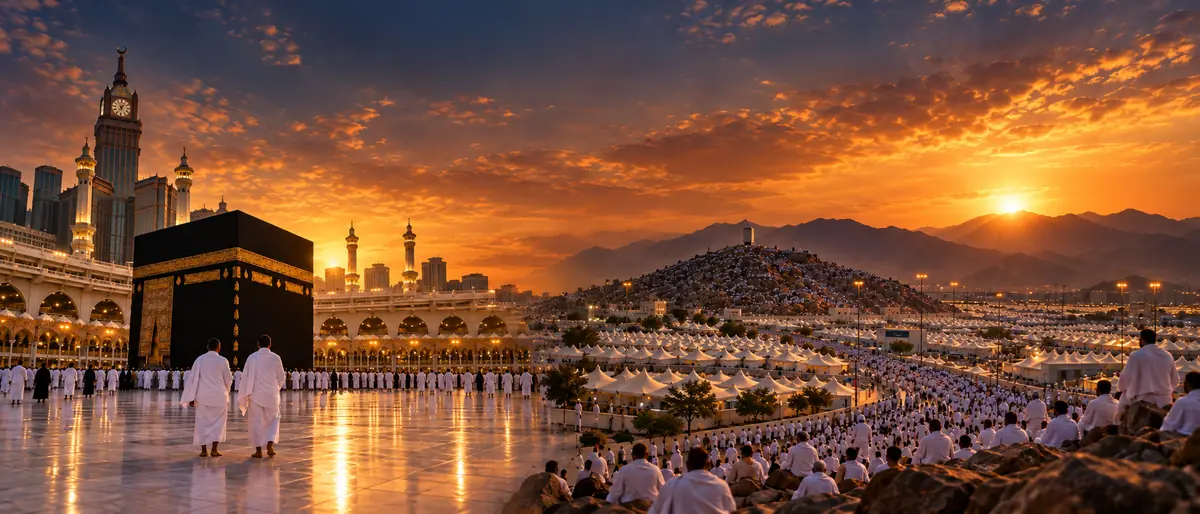
Umrah vs Hajj - Rituals, Cost, Timing & Rules
What’s the difference between Umrah & Hajj?
Hajj is one of the five pillars of Islam and is mandatory for every Muslim who is physically and financially capable of performing it once in a lifetime. Hajj takes place on specific days from the 8th to the 12th or 13th of Dhul Hijjah and includes several major rites in and around Makkah.
Whereas Umrah is a voluntary pilgrimage that can be performed at most times of the year. It involves fewer rituals than Hajj and usually takes around 3-6 hours, depending on the crowd and the pilgrim’s pace.
The two pilgrimages share some rites, such as Ihram, Tawaf and Sa‘i, but Hajj includes additional rituals and specific days of worship. Knowing these differences can help you prepare for its requirements and perform each ritual correctly.
Let’s learn the difference in detail:
Hajj vs Umrah: Quick comparison
Factor |
Hajj |
Umrah |
|---|---|---|
| Religious status | Fifth pillar of Islam; obligatory once for those who are able (Qur’an 3:97) | Performing Umrah is a Sunnah act, but scholars differ on whether it is obligatory |
| Timing | Specific days in Dhul Hijjah | Throughout much of the year, subject to Hajj-season restrictions |
| Duration | Main rites take around 5-6 days | Often completed in 3-6 hours |
| Main rituals | Ihram, Tawaf, Sa'i, Mina, Arafah, Muzdalifah, Ramy and other rites | Ihram, Tawaf, Sa'i and Halq or Taqsir |
| Location | Makkah, Mina, Arafah and Muzdalifah | Makkah, with Ihram beginning from the relevant Miqat |
| Crowds | Very large and concentrated during Hajj | Varies by season and date |
| Visa route | Hajj visa and approved Hajj booking route | Eligible Umrah visa and, for now, an entry route only outside the Hajj season is allowed by the Saudi Government |
| UK booking route | Official Nusuk Hajj route or approved package arrangements | Approved Umrah travel and visa routes |
| Cost | Usually much higher because of fixed dates, camps and Hajj services | Usually lower and more flexible |
| Reward | The Prophet ﷺ said that the reward of an accepted Hajj (Hajj Mabrur) is Paradise (Sahih al-Bukhari 1773). | Umrah has great virtue; Umrah in Ramadan has the reward of Hajj, according to authentic hadith (Sahih al-Bukhari 1782). One Umrah to the next expiates the sins committed between them (Sahih al-Bukhari 1773). |
| Does Umrah replace Hajj? | Hajj remains an obligation for a person who is required and able to perform it. | Umrah does not remove the obligation of Hajj. The hadith about Umrah in Ramadan describes its reward as equal to Hajj; it does not state that it fulfils the obligatory Hajj (Sahih al-Bukhari 1782). |
What is Hajj?
Hajj is the major pilgrimage to Makkah and the fifth pillar of Islam. It is obligatory once in a lifetime for a Muslim who is physically and financially able to perform.
The term Hajj means the pilgrimage to the Sacred House, and its rites follow the practices of two prophets, the Prophet Ibrahim عليه السلام and the Prophet Muhammad ﷺ.
The Quran states:
“And pilgrimage to the House is a duty owed to Allah by people who can find a way to it.” (Quran Chapter 3, Verse 97)
The Quran also commands Muslims to complete Hajj and Umrah for Allah (Chapter 2, Verse 196).
To understand the pilgrimage in greater detail, read our complete Hajj Guide covering its rules, rituals, preparation and key requirements.
Who must perform Hajj?
Hajj is obligatory for an adult Muslim who is:
- Muslim
- Sane
- Physically able
- Financially able
- Able to reach Makkah safely
- Able to meet the applicable conditions for the journey
- Free of debt
- Earns Halal
- Reached the age of Puberty
For more clarification, ask a qualified scholar.
When is Hajj performed?
Hajj takes place during Dhul Hijjah; it’s the final month of the Islamic calendar.
The main Hajj rites begin on the 8th of Dhul Hijjah and continue through the 13th. The Day of Arafah is on 9 Dhul Hijjah, and Eid al-Adha is on 10 Dhul Hijjah, entirely based on the lunar Islamic calendar.
Types of Hajj - Hajj Tamattu, Qiran and Ifrad
There are three recognised forms of Hajj:
Tamattu- The pilgrim performs Umrah during the Hajj season, exits Ihram and then enters Ihram again for Hajj.
Qiran- The pilgrim combines Umrah and Hajj in one Ihram without completing a separate exit from Ihram between them.
Ifrad- The pilgrim performs Hajj alone.
For UK pilgrims, the appropriate Hajj type depends on the package, personal circumstances and fiqh guidance. Do not assume one type is automatically suitable for every traveller.
What is Umrah?
Umrah is a pilgrimage to the Sacred Mosque in Makkah, also known as the lesser pilgrimage, that involves Ihram, Tawaf, Sa'i and either Halq or Taqsir.
Unlike Hajj, Umrah does not include standing at Arafah, staying at Muzdalifah or the Hajj days at Mina.
Is Umrah obligatory?
No, Umrah isn’t obligatory, but a highly rewardable Sunnah act.
There is a recognised scholarly difference over whether Umrah is obligatory once in a lifetime or a confirmed Sunnah.
Pilgrims should ask a qualified scholar for clarification.
Want to understand the complete process? Read our guide on how to perform Umrah step by step.
Types of Umrah - Umrah al-Mufradah vs Umrah al-Tamattu
- Umrah al-Mufradah is an independent Umrah that is not performed as part of Hajj Tamattu.
- Umrah al-Tamattu is performed as part of Hajj Tamattu. The pilgrim performs Umrah during the Hajj season, exits Ihram and later enters Ihram again for Hajj.
Ask a qualified scholar in case of any doubts.
Learn more about the different forms and requirements in our detailed guide to the types of Umrah.
Can you do Hajj and Umrah on the same trip?
Yes. A pilgrim can perform Umrah and Hajj during the same overall journey, depending on the Hajj type and applicable Saudi regulations. Hajj Tamattu specifically includes Umrah followed by Hajj, with the pilgrim leaving Ihram between the two.
How is Hajj performed step-by-step?
The Hajj pilgrimage is performed over several days of Dhul Hijjah, with pilgrims moving between Mina, Arafah, Muzdalifah and Makkah. Each day includes specific rites that must be performed in the correct place and according to the pilgrim’s Hajj type.
Here is a simple step-by-step overview of how Hajj is performed.
8 Dhul Hijjah - Mina
Pilgrims enter or remain in Ihram according to their Hajj type and travel to Mina.
They spend the day and night there while preparing for the Day of Arafah.
9 Dhul Hijjah - Arafah and Muzdalifah
The Day of Arafah is the central day of Hajj; pilgrims stand at Arafah and make dua, remember Allah and seek forgiveness.
After sunset, they proceed towards Muzdalifah, where they spend the night according to the Hajj arrangements and rulings that apply to them.
10 Dhul Hijjah - Eid al-Adha
Pilgrims perform key rites including:
- Ramy of Jamarat al-Aqabah
- Sacrifice where required
- Halq or Taqsir
- Tawaf al-Ifadah
The precise order and rules can differ according to the pilgrim's Hajj type and school of fiqh.
11-13 Dhul Hijjah - Mina
Pilgrims stay in Mina to continue the daily stoning rituals (Ramy) at the Jamarat.
Those who complete Hajj after the required rites perform the Farewell Tawaf right before leaving Makkah.
To learn in detail how to perform Hajj, click here.
What do Hajj and Umrah have in common?
Umrah and Hajj share several important features; they are as follows:
- Both are acts of worship.
- Both involve travel to Makkah.
- Both involve Ihram.
- Both include Tawaf.
- Both include Sa'i.
- Both require pilgrims to follow specific rules.
- Both are connected with the legacy of Prophet Ibrahim عليه السلام.
- Both require sincere intention and worship of Allah.
- Both have significant spiritual importance in Islam.
What Affects the Cost: Hajj vs Umrah from the UK
Here are the facts that affect the cost:
Cost area |
Hajj |
Umrah |
|---|---|---|
| Flights | Depends on airport, airline and chosen dates | Depends on season and booking date |
| Hotels | Makkah/Madinah accommodation plus Hajj arrangements | Makkah/Madinah accommodation |
| Visa | Hajj visa route | Eligible Umrah visa/entry route |
| Mina/Arafah | Included through Hajj arrangements | Not applicable |
| Transport | Holy-site transport is part of Hajj arrangements | Airport, Makkah and Madinah transport varies |
| Qurbani | Required in relevant Hajj types | Not a standard requirement for every Umrah |
| Overall price | 300 to 500% higher as compared to Umrah | Usually lower |
Booking Hajj and Umrah from the UK
Hajj planning requires more time, since it can only be performed during a specific period of time every year; now it becomes much years to book your Hajj via the official Nusuk platform of the Saudi Government.
On the other hand, Umrah planning takes time: finding what documents are needed, choosing the right hotels, transport, and choosing a licensed Umrah Travel partner can make it much easier for you, helping with the documents, best hotels, flights and transport.
What are Hajj 2027 dates?
The expected 2027 Hajj period is May 2027. (These dates are expected)
- 8 Dhul Hijjah (Hajj Begins) - Friday, 14 May 2027
- 9 Dhul Hijjah (Day of Arafah) - Saturday, 15 May 2027
- 10 Dhul Hijjah (Eid al-Adha) - Sunday, 16 May 2027
- 13 Dhul Hijjah (Hajj Concludes) - Wednesday, 19 May 2027
Dates may vary depending on the calendar; scrutinise carefully!
What should you check in a UK Travel Partner for Umrah?
Before paying, check the following:
- ATOL protection
- Company details
- Flight arrangements
- Hotel names and locations
- Umrah visa arrangements
- What is included in the package
- Transport
- Food arrangements
- Cancellation terms
- Room occupancy
- Whether the package is suitable for your passport and eligibility
When is a good time for Umrah?
Popular periods include:
- Ramadan
- December
- School holidays
- Winter months
- Annual leaves in UK
Visa Rules for UK Pilgrims
For Umrah: UK pilgrims need a valid Saudi visa or approved travel authorisation to perform Umrah.
For Hajj: UK pilgrims must use the official Hajj visa and follow the required booking, permit and travel arrangements. Note that a regular Umrah visa does not replace the Hajj visa.
Passport: Your UK passport should have a 6-month validity after entering Saudi Arabia, and you should check the latest visa conditions before travelling.
Health & Vaccination Requirements: Pilgrims 12 months or older must be vaccinated with Meningococcal AWCY and should meet Saudi Arabia’s current health and vaccination requirements before travelling for Hajj or Umrah.
Check the latest requirements for required vaccines, health certificates and any applicable medical conditions before departure.
For complete requirements, visa options and application guidance, see our Umrah visa guide for UK pilgrims.
Are you ready to Plan Your Umrah from the UK?
So now that you’ve understood the Hajj vs Umrah difference, it’s time to plan your journey with confidence.
Pick the most suitable Umrah package from the UK with carefully selected hotels, flights, transfers and visa support, all arranged around your travel dates and budget with Itimaar!
Explore our Umrah packages and start planning your journey today.
Frequently Asked Question
Can I perform Umrah on behalf of someone else?
Yes, you can. This Umrah is known as Umrah Badal. Make sure to ask a qualified scholar about the rulings before proceeding further.
What should I pack for Umrah from the UK?
Common things to pack are Ihram clothing, comfortable footwear, modest clothes, essential medicines, travel documents and suitable toiletries. And keep passport and visa details safely accessible during your journey.
What should I do if I miss my Miqat while travelling for Umrah?
You’ll have to return to the applicable Miqat boundary or the nearest Miqat and enter Ihram again. If you cannot return, a compensatory sacrifice will apply depending on your circumstances.
Can I cut my hair myself after completing Umrah?
Yes, you can shorten your own hair right after completing Sa‘i to finish your Umrah and leave the state of Ihram. Men may shave or shorten their hair, while women can only shorten a small portion of their hair.
