

Hajj Guide
Plan Your Tour
Kaaba-The Sacred House Of Allah
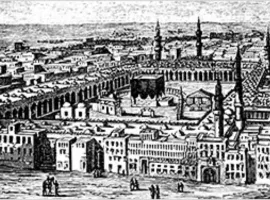
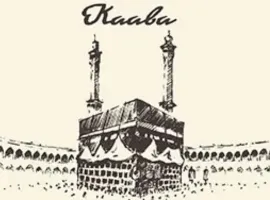
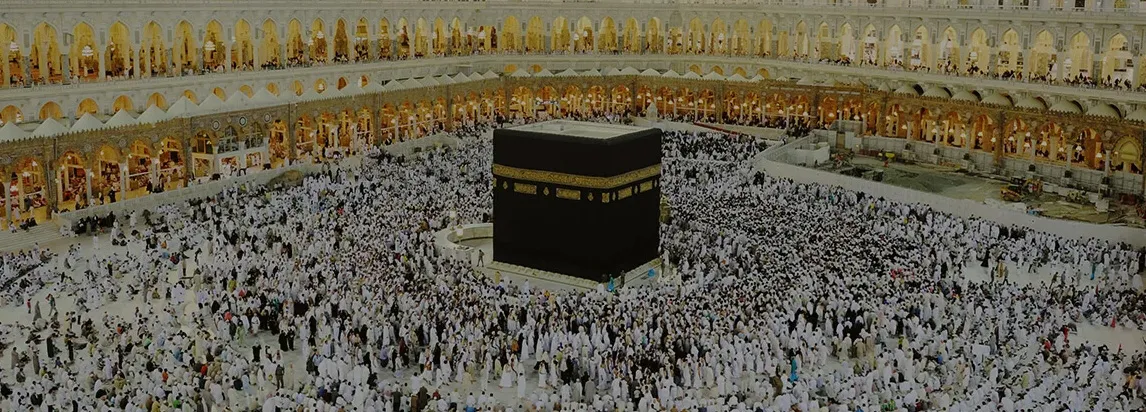
The Kaaba is the spiritual centre of Muslim worship and the most sacred structure in Islam. Located within Masjid al-Haram in the blessed city of Makkah, it is the Qiblah (direction) towards which Muslims across the world face during salah. The Kaaba is the focal point of the Hajj and Umrah pilgrimage and the first house of worship established for mankind.
Allah (SWT) says in the Qur’an:
“Indeed, the first House [of worship] established for mankind was that at Makkah – blessed and a guidance for the worlds.”
(Surah Aal-Imran 3:96)
Historical Significance of the Kaaba
The Kaaba was originally built by Prophet Ibrahim (AS) with his son Prophet Ismail (AS) upon the command of Allah. It was built as a place dedicated solely to Tawheed (Oneness of Allah) and a place of worship for mankind.
Allah says:
“And [mention] when Ibrahim was raising the foundations of the House and [with him] Ismail…”
(Surah Al-Baqarah 2:127)
Over time, the Kaaba underwent several reconstructions due to natural causes, yet its spiritual status remained unchanged. Before the advent of Islam, idols were placed inside it, but Prophet Muhammad ﷺ purified the Kaaba upon the conquest of Makkah, restoring it as a sanctuary of pure monotheism.
The sacred Kaaba is draped in a black silk cloth known as the Kiswah, embroidered with verses from the Qur’an in gold and silver thread. The Kiswah is replaced annually.
Many wrongly believe that muslims worship the Kaaba. The House of Allah, which is the Kaaba, is not worshipped; it is honoured as a symbol of obedience to Allah. Worship is directed only to Allah, not the structure itself.
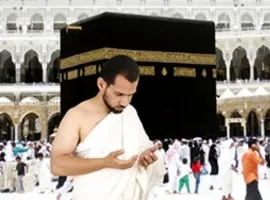
Standing before the Kaaba often brings overwhelming emotions: tears, humility, and deep reflection, reminding pilgrims of:
- Their purpose in life
- Equality before Allah
- The reality of the Hereafter
Key Parts of the Kaaba
Understanding the different parts of the sacred Kaaba helps pilgrims to perform the rituals correctly.
1. Hajar al-Aswad (The Black Stone)
Located at the eastern corner, it marks the starting point of Tawaf. Pilgrims try to kiss it or point towards it if unable to reach it.
The Prophet Muhammad ﷺ said: “The Black Stone came down from Paradise.” (Tirmidhi)
2. Maqam Ibrahim
A stone bearing the footprints of Prophet Ibrahim (AS), placed near the Kaaba. Pilgrims pray two rak‘ahs behind it after completing Tawaf. Praying two rak’ahs behind Maqam-e-ibrahim is an act of Sunnah.
3. Multazam
The space between the Black Stone and the Kaaba’s door. It is a highly recommended place for dua.
4. Bab al-Kaaba (Door of the Kaaba)
Situated above ground level and opened only on special occasions.
5. Hateem (Hijr Ismail)
A semi-circular wall adjacent to the Kaaba. It is part of the Kaaba, and praying inside it carries immense reward.
6. Mizab-ur-Rahmah
A golden spout from which rainwater flows off the roof of the Kaaba. Making dua beneath it is encouraged.
The Kaaba and Tawaf
Tawaf, the act of circumambulating the Kaaba seven times, is a central ritual of both Hajj and Umrah. Pilgrims walk counter-clockwise, keeping the Kaaba on their left.
The ritual of Tawaf symbolises:
- Unity of believers
- Complete Submission to Allah SWT
- The centrality of Allah in a Muslim’s life
Etiquettes When Near the Kaaba
- Maintain humility and calmness
- Avoid pushing or harming others
- Focus on dua and remembrance of Allah
- Do not raise voices or engage in arguments
- Respect the sanctity of the Haram
Apart from Hajj and Umrah, the Kaaba, House of Allah, remains central to a Muslim's life. The believers of Islam face it during every prayer. It unites over 2 Billion muslims worldwide, representing submission, unity and devotion.